Comprehensive Analysis of Wiegand and OSDP Protocols
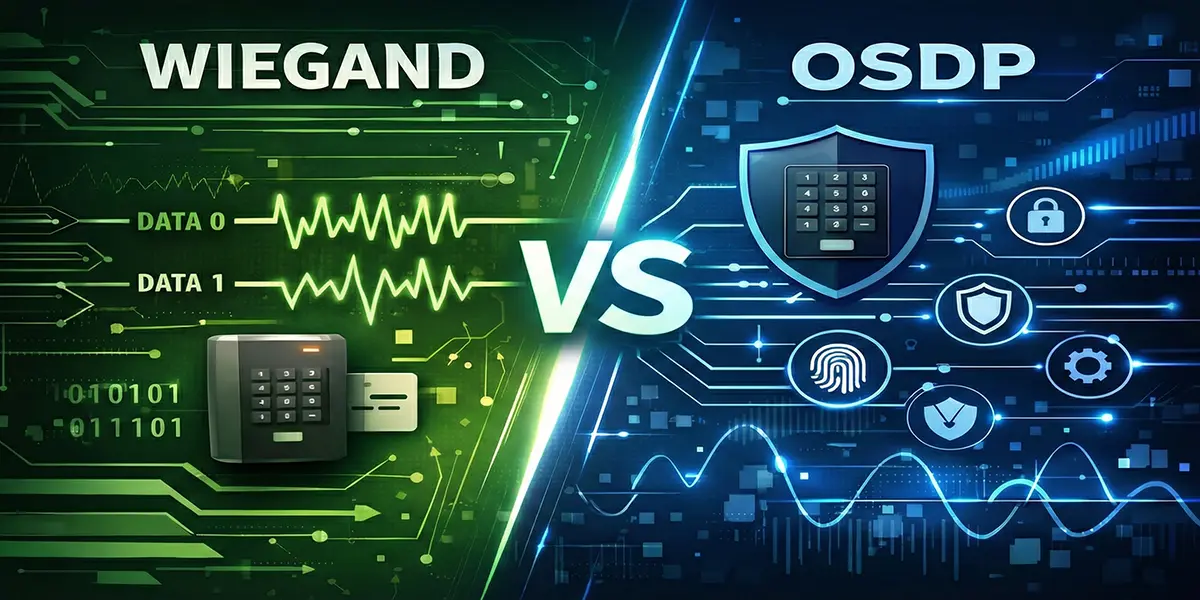
1. Introduction: The Criticality of Edge Communication in Modern Security
In physical security, the integrity of an Access Control System (ACS) depends as much — or more — on the communication link between the edge device (the card reader) and the controller as on server firewalls or physical doors. This “last mile” is often neglected. For decades the industry has used the Wiegand interface, a legacy standard that predates the internet and modern cyber-threats. As threats have evolved, the industry is shifting toward the Open Supervised Device Protocol (OSDP).
This report provides a technical analysis for commercial users, security architects, and systems engineers, covering physics, electrical specs, data structures, and security implications of both Wiegand and OSDP. The transition from Wiegand to OSDP is more than a component upgrade — it changes topology from passive, unidirectional signaling to an active, supervised, and encrypted device network. While Wiegand is ubiquitous by inertia, it is functionally obsolete for secure environments; OSDP (IEC 60839-11-5) supplies a modern framework for interoperable, secure access control.
2. The Wiegand Interface: Anatomy of a Legacy Standard
The term Wiegand refers to three things: the Wiegand effect (magnetic physics), the Wiegand wire (sensor), and the Wiegand interface (communication protocol). The interface governs connection between readers and panels globally.
2.1 The Physics of the Wiegand Effect
John R. Wiegand discovered unique magnetic properties in a processed ferromagnetic alloy (typically cobalt, iron, vanadium). The processed wire has a soft magnetic center and a hard magnetic shell. When exposed to a reversing external magnetic field, the wire undergoes a sudden reversal of magnetization — the Wiegand effect — inducing a sharp high-voltage pulse in a pickup coil. Crucially, pulse amplitude and width are independent of swipe speed, which made the effect ideal for early card readers. Modern readers emulate this behavior for backward compatibility with the 1980s Wiegand interface.
2.2 Electrical Specifications and Signaling
Wiegand is a low-level wired standard using three conductors:
- Data 0 (Green) — Data Low
- Data 1 (White) — Data High
- Signal Ground (Black) — Common reference
2.2.1 Voltage Potentials and Logic States
Signaling is single-ended; voltages are measured relative to ground. Idle state: Data 0 and Data 1 are pulled up (typically +5 VDC; sometimes +12 VDC). Transmission is asynchronous via short pulses to ground:
- '0' bit: reader pulls Data 0 low while Data 1 remains high.
- '1' bit: reader pulls Data 1 low while Data 0 remains high.
Using two physical wires allows easy bit distinction without clock synchronization but doubles conductor needs vs single-wire protocols.
2.2.2 Pulse Timing and Synchronization
Timing is critical:
- Pulse Width: ~50 µs (manufacturer range 40–100 µs)
- Pulse Interval (TPI): typically 2 ms (2000 µs)
A pause >TPI (e.g., >50 ms) indicates end of packet. Tight timing makes Wiegand susceptible to latency/jitter; missed pulses lead to lost bits, checksum errors, or invalid reads.
2.2.3 Electrical Distance Limitations
Wiegand’s high-impedance signals are sensitive to voltage drop and EMI. Cable capacitance rounds square pulses. Typical maximum cable runs: 500 ft (150 m) using 18 AWG shielded cable; in noisy environments this may be reduced to 200 ft to avoid phantom reads.
2.3 The Wiegand Protocol: Data Structure
Common format: 26-Bit Wiegand (H10301):
2.3.1 26-Bit Format Breakdown
- Leading parity bit (Bit 1): even parity over bits 2–13
- Facility Code (Bits 2–9): 8-bit site identifier
- Card Number (Bits 10–25): 16-bit user credential ID
- Trailing parity bit (Bit 26): odd parity over bits 14–25
Table 1 — Structure of the Standard 26-Bit Wiegand Format
| Bit Position | Function | Data Type | Range of Values | Description |
|---|---|---|---|---|
| 1 | Even Parity | Parity | N/A | Checks bits 2 through 13 |
| 2–9 | Facility Code | Integer | 0 – 255 | Designates the specific site installation |
| 10–25 | Card Number | Integer | 0 – 65,535 | Identifies the specific credential holder |
| 26 | Odd Parity | Parity | N/A | Checks bits 14 through 25 |
2.3.2 Limitations of Legacy Formats
The 26-bit format’s 8-bit Facility Code (256 sites) and 16-bit Card Number (65,535 badges) cause inevitable duplicates in large enterprises or multi-tenant buildings. Proprietary formats (e.g., 35-bit, 37-bit) expand address space but still use clear-text, raw pulses — fundamentally insecure.
3. Vulnerability Analysis: The Security Flaws of Wiegand
Wiegand operates on implied trust: the controller assumes any signal on Data 0/1 is legitimate. There’s no device authentication, encryption, or integrity checks beyond parity — opening the system to trivial and impactful attacks.
3.1 The “Bleeder” Attack (Passive Interception)
Because Wiegand is unencrypted voltage pulses, attackers can attach a passive bleeder device (microcontroller) to Data 0/1/Ground and record every credential. Devices like ESPKey or BLEKey (postage-stamp size) can be installed quickly behind readers or in wall cavities to capture and exfiltrate badge numbers over Wi-Fi or BLE, remaining invisible to SOCs.
3.2 The Replay and Cloning Attack
Captured credential data can be cloned to a blank RFID card or replayed by a bleeder device, which simulates proper timing on Data 0/1. Controllers cannot distinguish between reader and bleeder, enabling unauthorized access.
3.3 Lack of Supervision and Denial of Service
Wiegand is unidirectional: reader → controller. The controller cannot query reader status:
- If reader loses power, is smashed, or wires are cut, the controller sees silence — no offline signal. A door can remain unprotected.
- Tamper switches require extra wiring; often integrators omit tamper loops in cost-sensitive installs.
4. The Modern Standard: Open Supervised Device Protocol (OSDP)
OSDP (IEC 60839-11-5) addresses Wiegand’s structural deficiencies. It replaces analog pulses with packet-based digital serial communication, adding intelligence, encryption, and supervision.
4.1 RS-485: The Physical Layer of OSDP
OSDP uses RS-485 (TIA/EIA-485) over a shielded twisted pair.
4.1.1 Differential Signaling and Noise Immunity
RS-485 uses differential signals; the receiver reads the difference: $V_{AB} = V_A - V_B$.
- Logic 1 (Mark): $V_A < V_B$
- Logic 0 (Space): $V_A > V_B$
Differential signaling gives common-mode noise rejection and allows cable runs up to 4,000 ft (1,200 m) — about 800% more than Wiegand.
4.1.2 Multi-Drop Topology and Addressing
RS-485 supports a multi-drop bus (up to 126 devices on a pair). Each device gets a unique 7-bit address (0x00–0x7E). The Control Panel (CP) is Master; Readers (PDs) are Slaves. This reduces cabling costs because a single run can service multiple doors.
4.2 OSDP Packet Structure and Data Link Layer
OSDP sends packets with header, payload, and validation footer. A standard packet contains:
Table 2 — OSDP Packet Format (Standard Frame)
| Byte Offset | Field Abbreviation | Field Name | Description |
|---|---|---|---|
| 0 | SOM | Start of Message | Fixed value 0x53 (ASCII 'S') — synchronization byte |
| 1 | ADDR | Address | Address of PD (0x00–0x7E) + high bit for response |
| 2 | LEN_LSB | Length (LSB) | LSB of total packet length |
| 3 | LEN_MSB | Length (MSB) | MSB of total packet length |
| 4 | CTRL | Control Byte | Contains Sequence Number (SQN)... (continued in full spec) |
OSDP packets include CRC/Checksum (CRC-16 or 8-bit checksum) for error detection — a major improvement over Wiegand’s parity.
4.2.1 Error Detection
A CRC-16 is used. The receiver calculates CRC and compares; a mismatch causes discard and a Negative Acknowledge (NAK), preventing ghost reads or corruption from being treated as valid data.
4.3 Supervision and Session Management
OSDP introduces Supervision:
- Polling (osdp_POLL, Opcode 0x60): CP polls PDs.
- Device Health: PD replies
osdp_ACK(Opcode 0x40) if functional but idle. If a PD fails to reply (e.g., 5s silence), CP marks it OFFLINE. - Immediate Notification: Operators learn instantly if a reader is disabled, unlike silent failure in Wiegand.
5. OSDP Secure Channel: Cryptographic Assurance
OSDP’s Secure Channel (SCS) provides confidentiality, integrity, and authentication — critical for commercial and government applications.
5.1 AES-128 Encryption Implementation
SCS uses AES-128, typically in CBC mode, to encrypt payloads. Observers will see valid headers (SOM, ADDR, LEN) but encrypted payloads appear as random data.
5.2 The Secure Channel Handshake
Key steps in establishing a secure session:
-
Challenge (osdp_CHLNG): CP sends an 8-byte nonce to PD.
-
Cryptogram (osdp_CCRYPT): PD sends its random nonce and a cryptogram proving knowledge of the Secure Channel Base Key (SCBK).
-
Session Key Derivation: Both sides derive session keys:
- S-ENC: session encryption key
- S-MAC: session MAC/signing key
The SCBK is never transmitted. Session keys are ephemeral (regenerated on restart), preventing replay attacks.
5.3 Message Authentication Codes (MAC)
Every packet in SCS includes a 4-byte MAC from S-MAC. If a packet is tampered (bit flipped), the MAC will fail and the packet is rejected.
6. Advanced Functionality: Beyond Basic Access
OSDP turns readers into intelligent edge devices with bi-directional capabilities.
6.1 Interactive User Feedback (LED and Buzzer)
Rather than separate wires for LED/buzzer, OSDP sends software commands:
- osdp_LED (0x69): define LED patterns (e.g., flash amber 200ms ON/OFF for 5s).
- osdp_BUZ (0x6A): trigger distinct buzzer tones (e.g., propped vs forced door).
6.2 Text and Display Control
Readers with LCD/OLED can receive osdp_TEXT (0x6B) to display ASCII strings (e.g., “Welcome, John” or specific denial reasons), reducing help desk calls.
6.3 Biometric Template Management
OSDP supports osdp_BIOREAD and osdp_BIOMATCH. Biometric templates can be centrally managed: controllers store templates and either push templates to readers or perform match-on-server workflows — useful for FICAM/PIV compliance.
7. Vulnerabilities in OSDP Implementation
OSDP is secure by design, but not secure by default — poor implementation/configuration adds risk.
7.1 The “Install Mode” Risk
Many readers ship in Install Mode, using a default SCBK (sometimes publicly known). If integrators do not provision a unique SCBK after installation, attackers who know the default can decrypt traffic. Mitigation: disable Install Mode immediately after commissioning.
7.2 The Daisy Chain Key Exposure
Adding a new reader to a live daisy chain can expose the new device’s keys if the controller provisions SCBK over the bus using the installer key. An attacker monitoring the bus can capture provisioning messages and compromise the new reader (and maybe others). Mitigation: provision keys on a secure, isolated connection before installing on the public bus.
8. Implementation Strategy: Wiring and Engineering
Migrating from Wiegand to OSDP requires correct RS-485 engineering; neglect of the physical layer causes unstable installs.
8.1 Cabling and Topology
- Cable Type: Use Shielded Twisted Pair (STP), 120 Ω characteristic impedance (e.g., Belden 9842/8723). Unshielded security cable causes impedance mismatches and reflections.
- Topology: Daisy chain (linear bus). Avoid star/T-tapping; if unavoidable, use an RS-485 hub/splitter.
8.2 Termination and Biasing
- Termination: 120 Ω resistor across Data A/B at both ends (controller and last reader). Intermediate devices must not be terminated.
- Failsafe Biasing: Ensures known logic state when bus is idle to prevent noise being misread as data.
8.3 Grounding and Isolation
Ground loops are a common retrofit issue. Best practices:
- Connect shield/drain at panel end only.
- For high-noise environments, use optical isolation on OSDP ports to separate controller from field wiring.
9. Troubleshooting and Diagnostics
OSDP diagnostics require packet analysis tools rather than just a multimeter.
9.1 The “NAK” Analysis
Common NAKs (Negative Acknowledge codes):
- NAK 0x01 (Message Check Error): CRC failure — usually physical layer problem (bad cabling, missing termination, noise).
- NAK 0x05 (Security Block Not Supported): Reader lacks requested encryption.
- NAK 0x06 (Encrypted Required): Reader requires encryption but the panel used cleartext.
9.2 Tools of the Trade
- USB-to-RS485 adapter: connects laptop to bus.
- Protocol sniffers: e.g., Cypress OSDP Trace Tool to capture hex on the wire and verify headers and whether payloads are encrypted.
10. Conclusion and Recommendations
Wiegand is an analog relic — functional but insecure, limited, and blind to its own health. OSDP matures physical security into the IT era:
Benefits of OSDP
- Security: AES-128 secure channel prevents cloning and eavesdropping.
- Intelligence: Bi-directional communication enables health monitoring, richer feedback, and centralized management.
- Efficiency: Multi-drop cabling reduces cost; remote management reduces service calls.
Recommendations
- New installations: Require OSDP Secure Channel; specify “SIA OSDP Verified” devices for interoperability.
- Existing Wiegand sites: Phase migration; prioritize perimeter/high-security areas (e.g., server rooms). Where rewiring is costly, use OSDP-to-Wiegand converters on the secure side of the wall to introduce encryption near the edge.
- Configuration: Enforce Secure Channel Required, disable Install Mode immediately after commissioning.
In modern threat environments, migration to OSDP is a matter of when, not if. The cost of inaction (breaches, lack of visibility) typically exceeds upgrade costs.
Frequently Asked Questions
In many cases, yes. Most modern access control panels from major manufacturers (Mercury/HID, Axis, AMAG, Lenel) support both Wiegand and OSDP on the same reader ports through a firmware update or configuration change. You switch the port mode from Wiegand to OSDP in the panel software, then connect the new OSDP reader using the same RS-485 pair. However, older legacy panels (pre-2015 or discontinued models) may lack OSDP support entirely, requiring a panel upgrade. Check your panel manufacturer's OSDP compatibility matrix before committing to a migration timeline.
Wiegand is limited to approximately 150 meters (500 feet) of cable run due to its reliance on voltage-level signaling that is susceptible to noise and signal degradation. OSDP over RS-485 supports up to 1,200 meters (4,000 feet) at 9,600 baud on a properly terminated twisted pair, because RS-485 uses differential signaling that rejects common-mode noise. In practice, keep OSDP runs under 1,000 feet with 24 AWG shielded twisted pair for reliable communication, and use proper 120-ohm termination resistors at both ends of the RS-485 bus.
Basic OSDP without Secure Channel still provides significant advantages over Wiegand: bidirectional communication, reader supervision (tamper detection, heartbeat monitoring), and support for multi-technology credentials. However, without Secure Channel, card data still travels in cleartext on the RS-485 bus and can be intercepted with a bus tap. For any deployment handling sensitive facilities, government buildings (FICAM/FIPS 201 compliance), or environments where reader-to-panel wiring traverses unsecured areas, Secure Channel with AES-128 encryption is strongly recommended. SIA OSDP v2 mandates Secure Channel support for OSDP-verified devices.
The RS-485 standard supports up to 32 unit loads on a single bus segment, and most OSDP readers represent 1 unit load. In practice, most access control panels support 2-4 OSDP readers per RS-485 port depending on the panel architecture. Each reader is assigned a unique address (0-126) on the bus. Daisy-chaining reduces cabling by running a single twisted pair from reader to reader, but be aware that a cable break between readers will isolate all downstream devices. For critical doors, use a home-run topology (one reader per cable) to avoid single-point-of-failure conditions.
Yes. OSDP defines the communication protocol between the reader and the panel—it does not dictate the credential technology. An OSDP reader that supports HID prox (125 kHz), iCLASS, SEOS, or MIFARE will read those credentials exactly as before and transmit the card data to the panel over the encrypted OSDP channel instead of Wiegand wires. This means you can upgrade readers to OSDP without issuing new badges to all cardholders. However, if your current credentials are 26-bit HID prox, consider upgrading to higher-security credentials (SEOS, DESFire) during the migration to address the credential-level vulnerability, not just the reader-to-panel link.