Plenum Cable Requirements (CMP) — Where It’s Required (and Why)
Compliance Guide for Security and Low Voltage Deployments: Plenum Cable Requirements (CMP) — Where It’s Required (and Why)
Navigating plenum cable requirements is a critical step in any commercial physical security or low-voltage deployment. Using the wrong cable jacket rating in an air-handling space can lead to failed inspections, expensive rework, and severe life-safety hazards. This guide breaks down exactly when and why CMP (Communications Multipurpose Plenum) cable is required, how to field-verify an air-handling space, and how to prove compliance to an inspector.
TL;DR
- If a cable routes through an exposed air-handling plenum (like an open-return drop ceiling), you must use CMP cable unless the AHJ approves an alternative.
- Plenum-rated cables restrict flame spread and limit the emission of toxic smoke, protecting occupants who breathe recirculated air from the HVAC system.
- CMR (Riser) cable prevents vertical flame spread but produces highly toxic smoke, making it unacceptable for exposed horizontal runs in plenum spaces.
- Enclosing non-plenum cable in continuous, approved metallic raceway often satisfies the code, but AHJ interpretations vary.
- Inspectors look at the entire pathway; a single non-plenum patch cord or standard zip tie in a plenum space can fail the entire installation.
Who This Is For
- Low-voltage installers and security integrators: Routing cable pathways, estimating job costs, and passing rough-in inspections.
- Facilities managers: Overseeing vendor compliance and maintaining building safety standards during renovations.
- IT/network teams: Sourcing materials and managing the physical layer of security and network endpoints.
- Procurement: Specifying bills of materials (BOMs) accurately to prevent contractors from substituting non-compliant wire.
Key Terms
-
Plenum space: Technically described in the code as "Other Spaces Used for Environmental Air," this is any building cavity utilized to circulate environmental air back to the HVAC system.
-
CMP (Communications Multipurpose Plenum): The highest fire rating for low-voltage copper cabling. Emits minimal smoke and self-extinguishes.
-
CMR (Communications Multipurpose Riser): Cable rated for vertical runs between floors. Designed to prevent upward flame spread but lacks the low-smoke properties of CMP.
-
CM/CMG (Communications Multipurpose General): Standard jacket rating for general, in-wall use within a single floor (non-plenum, non-riser).
-
AHJ (Authority Having Jurisdiction): The local building official, fire marshal, or inspector who legally enforces code interpretation and compliance.
-
Return air: Air pulled from the occupied building space back to the HVAC unit.
-
Ducted vs open return: A ducted system uses continuous sheet metal to move air. An open (or unducted) system uses the empty structural cavity to channel the air.
What a Plenum Space Is (in the Real World)
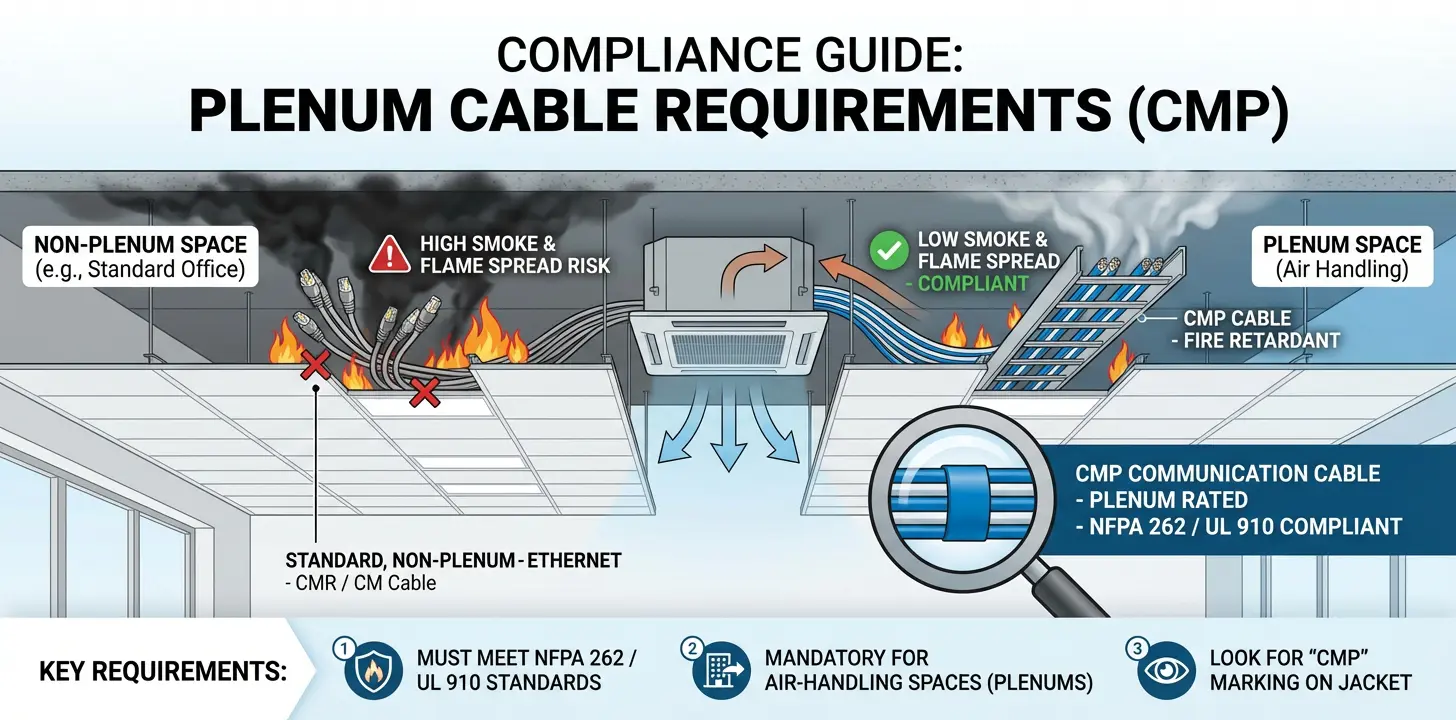
To an inspector evaluating NEC plenum spaces, a plenum is any space handling environmental air that is not enclosed in a fabricated duct. If toxic smoke enters this space, the HVAC system will distribute it to occupied offices.
Practical Examples of Plenum Spaces (CMP Required)
- Drop ceilings used as return air: The HVAC supplies air through ceiling vents, but return air flows through open "egg crate" grilles directly into the ceiling void.
- Raised computer room floors: The space beneath data center floor tiles utilized to distribute cold air up to server racks.
- Mechanical equipment rooms: When the room itself acts as an un-ducted air-mixing box for the building's ventilation.
- Above-ceiling air shafts: Open architectural cavities that connect directly to main HVAC return shafts.
- Stud cavities used for air handling: Wall cavities explicitly built to channel return air back to a unit.
- Open joist cavities in retrofits: Spaces between structural floor joists that have been sealed off to move air where traditional ducting will not fit.
Non-Examples (CMP Generally Not Required)
- Fully ducted return systems: Both supply and return air are entirely enclosed in sheet metal ducts. The void above the drop ceiling contains static or "dead" air.
- Standard interior stud walls: Drywall partitions with no environmental air movement.
- Cable routed inside conduit: Cabling pulled entirely inside continuous electrical metallic tubing (EMT) outside the air space. (Verify AHJ rules on conduit inside a plenum).
- Slab-to-slab exposed warehouse ceilings: Open-concept environments where cable is suspended directly in the occupied room, assuming no distinct air-handling void exists.
Verification: How to Confirm Plenum Status
Do not guess if a space is a plenum. Verify it using these methods:
- Check mechanical drawings: Look for "open return" or "plenum return" on the HVAC design plans.
- Lift a ceiling tile: Inspect the return grilles. If a sheet metal duct connects the grille to the main unit, it is a ducted return. If the grille opens directly into the ceiling void, the space is a plenum.
- Consult facilities contacts: Ask the building engineer how the return air routes back to the main handlers.
- Consult the AHJ: If documentation is missing, request a formal classification from the local inspector.
Navigating Plenum Cable Requirements: Where CMP is Required (and Common Exceptions)
Determining the correct fire rating low voltage cable requires mapping your cable path against the building's mechanical design. This decision guide follows standard NFPA 70 rules.
Decision Flow: CMP vs CMR vs Conduit
- Is the cable path vertical between floors in a dedicated shaft?
- Yes: CMR is the minimum requirement (CMP is also acceptable).
- No: Proceed to the next step.
- Does the cable path enter a drop ceiling, raised floor, or enclosed cavity?
- No (e.g., standard in-wall or exposed open ceiling): CM/CMG is acceptable.
- Yes: Proceed to the next step.
- Is the space above the ceiling or below the floor used for environmental air return/supply?
- No (it is fully ducted): CMR or CM is generally acceptable.
- Yes (it is an open return): CMP is strictly required. (Proceed to the next step for exceptions).
- Exception Check: Will the cable be installed entirely within continuous metallic conduit?
- Yes: Non-plenum cable may be allowed inside the conduit per the NEC, as it isolates the cable from the air space.
- No: CMP must be used.
"Ask the AHJ" Callout
When in doubt, consult the Authority Having Jurisdiction before buying materials.
What to ask: "Does the municipality enforce strict NEC Chapter 8 plenum rules based on HVAC design, or are there local amendments requiring CMP building-wide regardless of the ceiling type?"
Conduit clarification: "If we run continuous EMT through the open return air space in Suite 100, will you accept CMR cable inside that raceway?"
CMP vs CMR vs CM: What the Markings Mean
Understanding CMP vs CMR and general cable jacket ratings ensures compliance and safety. CMP uses specialized fluoropolymers (like FEP) that self-extinguish and emit very little smoke. CMR uses standard PVC that resists upward vertical flame spread but emits thick, toxic smoke.
Cable Jacket Rating Comparison
| Feature | CMP (Plenum) | CMR (Riser) | CM/CMG (General) |
|---|---|---|---|
| Typical Use Area | Above drop ceilings, raised floors (air-handling) | Vertical shafts between floors | Standard walls, single-floor non-air spaces |
| Smoke/Toxicity | Extremely low smoke, low toxicity | Moderate-to-heavy toxic smoke | Standard toxic smoke |
| Flame Spread | High resistance, self-extinguishing | Resists upward vertical spread | Basic resistance |
| Cost Impact | Highest cost (premium jacket materials) | Moderate cost | Lowest cost |
| When to Default to It | Open returns, healthcare, when HVAC design is unknown | Dedicated risers, fully ducted commercial spaces | Residential, basic in-wall office drops |
What to Look for on the Jacket
Inspectors actively look for the correct markings. The outer jacket must physically have "CMP" or "Type CMP" printed on it alongside the wire gauge (AWG) and a Nationally Recognized Testing Laboratory (NRTL) mark (e.g., UL or ETL).
Procurement: Specifying Cable to Avoid Counterfeits
Procurement teams must aggressively specify materials to prevent unsafe substitutions:
- Require UL/ETL Verification: Demand "UL Listed" or "ETL Verified" marks on the BOM.
- Demand Solid Bare Copper: Copper Clad Aluminum (CCA) is explicitly banned by the NEC for PoE applications due to heat resistance issues, regardless of its CMP/CMR jacket label.
- Check the Box Holograms: Counterfeiters often print "CMP" on the cable jacket but lack the independent testing laboratory holographic stickers on the pull box.
- Understand the plenum vs riser cable substitution rule: CMP can legally substitute for CMR or CM. CMR can substitute for CM. You cannot substitute CM or CMR into a plenum space.
Installation Notes That Affect Compliance
Buying the right CMP cable is only the first step. Installation methods strictly dictate code compliance in a structured cabling plenum environment.
- Bundling and Heat (PoE): Plenum spaces are naturally warm. When running heavy Power over Ethernet (PoE++ / Type 4) to access control panels or PTZ cameras, dense cable bundles generate internal heat. NEC Article 725 limits bundle sizes to prevent cables from exceeding their temperature ratings.
- Separation from Electrical: Low-voltage must maintain physical separation from high-voltage electrical lines (typically a minimum of 2 inches, though more is recommended for data integrity).
- Penetrations and Firestopping Basics: If CMP cable passes through a fire-rated wall, the penetration must be sealed with approved, intumescent firestop putty or caulk. The CMP rating does not replace the requirement for physical firestopping.
- Handling Abandoned Cable: NEC Article 800.25 mandates the removal of accessible abandoned communications cables in plenum spaces. Do not leave cut, unused cables behind; they add combustible mass to the building. Remove them or explicitly tag them "For Future Use."
8 Common Mistakes That Fail Inspections
Avoid these field errors to ensure your project passes inspection:
- Using CMR patch cords in a plenum space: Plugging a ceiling-mounted camera into a surface mount box above the grid? That patch cord must also be plenum-rated.
- Assuming "no drop ceiling" means "no plenum": Open-concept environments sometimes use the entire upper deck as an air return.
- Using standard nylon zip-ties: Standard zip-ties melt and produce toxic smoke. In strict jurisdictions, non-metallic supports must be plenum-rated (e.g., maroon AH-2 rated ties or plenum hook-and-loop).
- Zip-tying to ceiling support wires: NEC prohibits using suspended ceiling grid support wires to hold up low-voltage cables. You must install independent support (J-hooks) anchored to the building structure.
- Leaving cut cable in the ceiling: Failing to remove abandoned cable or failing to label unused cable.
- Poking holes in fire walls: Running CMP cable through a firewall but failing to install a firestop sleeve.
- Mixing cable ratings: Accidentally pulling one CMR cable into a bundle of twenty CMP cables will fail the entire bundle.
- Throwing away the cable boxes early: Discarding the bulk boxes removes the UL holographic proof that inspectors often request during rough-in.
Example Scenarios
Scenario 1: Standard Commercial Office Space
- Environment: Office with a drop ceiling. The HVAC supplies air through diffusers; return air flows through egg-crate grilles directly into the ceiling void.
- Cable Path: From the IT closet, across the drop ceiling, down inside the drywall to card readers.
- Decision: CMP.
- Reasoning: The void above the drop ceiling is an active return air plenum. All exposed cable in this space must be CMP.
Scenario 2: High-Rise Elevator Lobby
- Environment: 10th floor of a high-rise. The ceiling has fully ducted supply and return HVAC.
- Cable Path: Camera cable runs from the 5th-floor MDF, up a vertical telecommunications shaft to the 10th floor, then horizontally above the fully-ducted ceiling to the lobby.
- Decision: CMR. (CMP is also permitted).
- Reasoning: The vertical shaft requires CMR to prevent vertical fire spread. Because the 10th-floor ceiling is fully ducted, the ceiling void is not a plenum space.
Scenario 3: Exterior Security Camera
- Environment: Surface lot camera mounted on a pole.
- Cable Path: From the indoor IT room, through an open-return drop ceiling, out the exterior brick wall, and underground via PVC conduit to the pole.
- Decision: Continuous conduit OR transition from CMP to OSP.
- Reasoning: Standard OSP (Outside Plant) cable is highly toxic in a fire and cannot run exposed in a plenum. Standard CMP cannot survive underground moisture. You must run continuous metallic conduit through the plenum to hold the OSP cable, or pull CMP indoors and splice to OSP cable within 50 feet of the building entrance.
Scenario 4: Clean Room Retrofit
- Environment: A laboratory with a plenum-rated ceiling. The facility requires extreme physical security for the cabling.
- Cable Path: Camera cables are routed entirely inside sealed, continuous rigid metal conduit (EMT) from the IT room to the camera mount.
- Decision: CMR or CM inside conduit.
- Reasoning: Because the cable is completely encased in continuous metallic raceway, it is physically separated from the environmental air. Non-plenum cable is acceptable inside the conduit (though many installers pull CMP anyway to simplify truck stock).
Jobsite Checklist
Provide this checklist to technicians for job walks and submittals.
Pre-Walk Questions
- [ ] Have we verified the HVAC return design (ducted vs. open) with the mechanical drawings or facilities contact?
- [ ] Is there a local code amendment requiring CMP building-wide regardless of HVAC design?
- [ ] Has all abandoned low-voltage cable in our path been removed?
Materials Verification
- [ ] Does the cable jacket explicitly read "Type CMP" and note solid copper (no CCA)?
- [ ] Are holographic UL/ETL labels present on the bulk cable boxes/reels?
- [ ] Are all above-ceiling patch cords also CMP rated?
- [ ] Are our zip ties and hook-and-loop straps plenum-rated?
Documentation to Keep
- [ ] Photos of the installed cable jacket print legend.
- [ ] Submittal datasheets and photos of the bulk box labels.
- [ ] Photos of independent J-hook supports and sealed fire penetrations.
- [ ] Updated as-builts detailing the exact cable paths and abandoned cable removed.
FAQs
Is CMP required above every drop ceiling?
No. CMP is only legally required if the space above the drop ceiling is used to circulate environmental air (an open return). If the HVAC system uses physical sheet metal ducts for both supply and return, the space is not a plenum, and CMR/CM cable is acceptable under standard NEC rules.
Can I run CMR in plenum if it’s in conduit?
Under standard NEC rules, yes. If non-plenum cable is entirely enclosed in a continuous, non-flexible metallic tubing (like EMT) without gaps, it is isolated from the air-handling space. However, local AHJs frequently amend this rule to require CMP regardless of conduit, so verify locally.
What if the building has fully ducted return air?
If the return air is entirely contained within sheet metal ductwork, the ceiling void is "dead air" and not a plenum. You can typically use CMR or CM cable in this space, provided there are no local amendments overriding this allowance.
Does plenum rating matter for security camera cable?
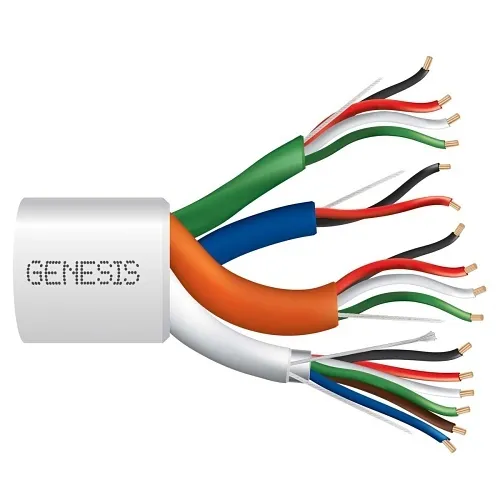
Yes. NFPA 70 rules apply to the physical jacket of the cable, not the data it carries. Ethernet, coaxial, composite access control wire, RS-485, and fire alarm wire must all meet plenum requirements if they pass exposed through a plenum space.
Can I use CMP cable in a riser shaft?
Yes. Fire ratings are hierarchical. CMP is the highest rating and can be substituted downward. You can use CMP in a riser (CMR) space, and you can use CMP in a general (CM) space. You cannot do the reverse.
What is the difference in smoke toxicity between plenum and riser?
Riser (CMR) jackets are typically made of standard PVC, which emits thick, black, highly toxic smoke and halogens when burned. Plenum (CMP) jackets use low-smoke fluoropolymers (like FEP) that emit very little smoke and self-extinguish, protecting building occupants from breathing toxic fumes.
Are zip ties allowed in plenum spaces?
Yes, but standard nylon zip ties can melt or emit toxic smoke. In strict jurisdictions, you must use special maroon-colored, plenum-rated zip ties (AH-2 rated) or plenum-rated hook-and-loop straps.
Do I need plenum-rated J-hooks?
Standard all-metal J-hooks are inherently fire-resistant and do not require a special plenum rating. However, any plastic attachments, saddles, or cable ties used in conjunction with them must be plenum-rated if installed in a plenum space.
Suggested Products to Consider
When spec'ing your BOM, ensure your procurement team accurately targets these product categories:
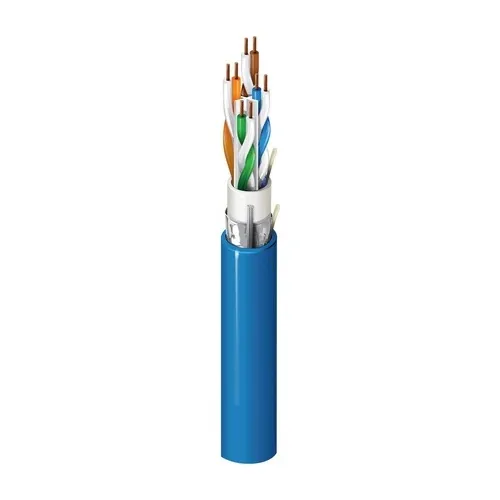
- CMP Cat6 solid copper: The baseline requirement for modern PoE cameras, Wi-Fi access points, and IP access control run through air-handling ceilings. Selection note: Look for UL/ETL listings and avoid CCA.
- CMR Cat6 solid copper: Acceptable for vertical riser shafts or fully ducted ceiling spaces. Selection note: A cost-effective alternative to CMP, but strictly verify HVAC design before purchasing.
- Plenum-rated patch cords vs in-wall cable: Required when patching directly into edge devices (like cameras or APs) mounted within the ceiling grid. Standard patch cords are CM-rated and will fail inspection if left exposed in a plenum. Bulk in-wall cable is solid copper for long runs, whereas patch cords use stranded copper for flexibility.
- Raceway and conduit accessories: Continuous EMT conduit, fittings, and firestop putty pads. Using metal pathways can bypass the need for plenum-rated cable in certain zones, provided the AHJ approves.
- Labeling and documentation supplies: Self-laminating cable wrap labels. Proper labeling proves to inspectors what type of cable was run and allows you to legally tag unused lines as "For Future Use" to avoid forced removal under the abandoned cable rule.
Assumptions made:
- This guide assumes the installation occurs within the United States under standard provisions of the National Electrical Code (NFPA 70), specifically Articles 300.22, 725, and 800.
- The deployment involves standard power-limited circuits (Class 2 / Class 3) and structured cabling (Cat5e/Cat6/Cat6A).
Sources to verify internally:
- Adopted code edition: Electrical codes are adopted and amended on a state-by-state and municipal basis. Confirm your local adopted code edition (e.g., 2020 vs 2023) with your local Building and Permitting Department.
- Local amendments: Verify if the municipality has strict local amendments overriding standard NEC allowances (e.g., mandating conduit for all low-voltage runs).
- AHJ guidance: Always seek written clarification from the local inspector on mixed environments or historical buildings prior to the job walk.
Frequently Asked Questions
CMP cable is required whenever cable is routed through a plenum space—any building cavity used for air handling, including the space above a dropped ceiling that serves as the HVAC return air path, and raised floor cavities used for supply air. If the ceiling space has ducted returns (air returns through enclosed metal ducts, not the open cavity), that space is typically not classified as plenum, and CMR or CM cable may be acceptable. Always verify with the project's mechanical drawings and the local AHJ, as interpretations vary by jurisdiction.
It depends on the conduit type and local code interpretation. NEC Article 300.22 allows wiring in metal conduit (EMT, rigid) within plenum spaces regardless of cable rating, because the conduit contains the smoke and flame. However, if you use non-metallic conduit (ENT/smurf tube), the conduit itself must be listed for plenum use. Some AHJs do not accept conduit as a substitute for CMP cable in any condition. Confirm with your local inspector before bidding—rework to CMP cable after the fact is extremely expensive.
Check three things: (1) the jacket should be printed with 'CMP' or '(CL2P/CL3P for low-voltage)' along with the UL or ETL listing mark, manufacturer name, and part number at regular intervals; (2) the cable reel or box should have a matching UL/ETL label with the listing file number; (3) you can verify the listing file number on UL's Product iQ database (productiq.ulprospector.com) or ETL's directory. If the cable is suspiciously cheap, has inconsistent jacket printing, or lacks a verifiable listing number, do not install it—counterfeit plenum cable is a real problem in the industry and will fail smoke density testing.
CMP cable typically costs 30-60% more than equivalent CMR cable due to the specialized low-smoke FEP or LSZH jacket compounds. For a 1,000-foot box of Cat6, expect to pay roughly $150-200 for CMR versus $250-350 for CMP (prices vary by manufacturer and copper market). On large projects with hundreds of cable runs, this adds up fast. Always survey the building's air handling design during the site walk to accurately count plenum vs. non-plenum pathways before submitting your bid—underestimating CMP requirements is a common margin killer.
Yes. Fiber optic cables routed through plenum spaces must be listed as OFNP (Optical Fiber Nonconductive Plenum) or OFCP (Optical Fiber Conductive Plenum). Standard OFNR (riser) or OFNG (general) rated fiber is not permitted. The same NEC Article 770 hierarchy applies: plenum-rated fiber can substitute downward (used in riser or general-purpose spaces), but riser-rated fiber cannot substitute upward into plenum spaces. Plenum-rated fiber typically costs 20-40% more than riser-rated equivalents.
Related Products